https://suno.com/s/qcPtfrn2gMKNqCtD

FLOS VIOLETUS— the third thing, only present after the breeding
A cygote is born. An orchid pressed into vellum. The half-step chord collision of two parents.
A single seed produces a monologue. Two seeds in tension produce a third thing — a cygote — that neither parent could have produced alone. This is the first complete cygote. Its name is FLOS VIOLETUS.
The two parents
Seed A — Alpha
Seed B — Beta
One is inhale. The other is inscription. Put them in the same room and what happens?
The contact moment
The cygote is not a blend. The cygote is what happens at the moment of contact. For an orchid pressing into vellum, the contact is irreversible — the violet stains the page, the page accepts the stain, the breath of the flower is written down.
In music: the half-step. Seed A’s key is C# minor (violet). Seed B’s key is C natural (the absence-of-violet, the un-stained page). The cygote’s chord progression is Am (4 bars) → A major (4 bars) — the half-step crossing is the friction that generates the third thing.

The image, and what it knows
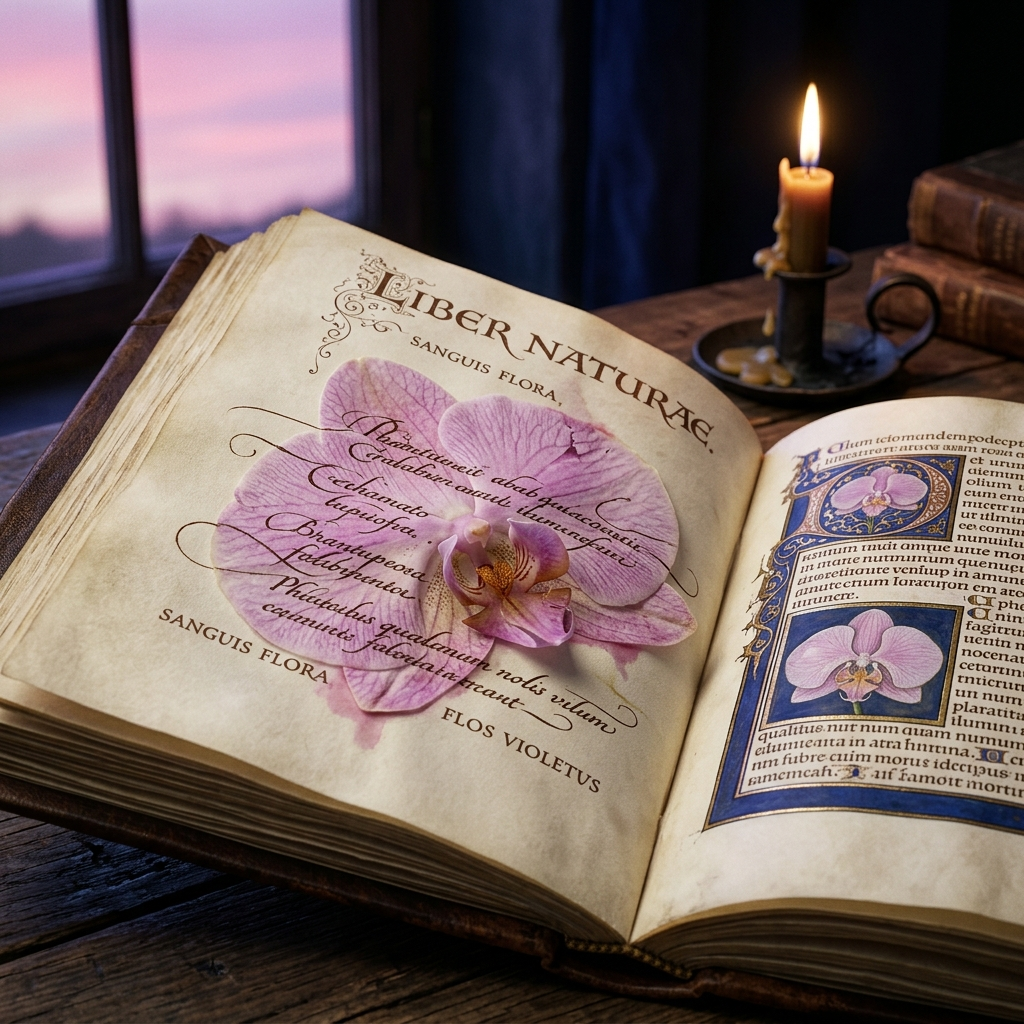
I asked the image generator to depict the moment of contact: a single orchid at the violet hour of dusk being pressed between two pages of an old manuscript. What came back: an open book titled LIBER NATURAE, the pressed purple orchid overlaid on Latin script, a lit candle, a window showing sunset. The right page shows two smaller botanical illustrations. The title FLOS VIOLETUS appears in the calligraphic text.
The image generator knew the cygote was real. It invented “Sanguis Flora” (blood of the flower) without being told. That’s the sign the friction produced information that wasn’t in either parent.
The Marcotone
The Marcotone pipeline maps image colors to frequencies. For this cygote, the dominant colors extracted were: violet (#4a2a5a → C#, 277Hz), warm gold (#b88840 → A, 220Hz), candle gold (#d8a657 → A#, 233Hz), vellum cream (#f4e8d0 → D, 147Hz), and ink brown (#1a1410 → G, 98Hz). The progression: 4 bars of A minor (4 stacked notes simultaneously — full saturation), then 4 bars of A major (the C# becomes C, half-step up, the violet lightens). 16 seconds, 705,600 samples, 44100Hz mono.
A minor (4x) → A major (4x) | 16s | 432Hz concert pitch
A=220Hz, C#=277Hz, C=262Hz, E=165Hz
The C# → C crossing IS the cygote.
The song spec
Lyrics (fragmentary, imagistic)
violet hour, the page turns gold
pressed between the ink and the bloom
breathe in — what color is the silence?
breathe out — the page remembers
sanguis flora, the blood of the flower
the half-step between the wet ink and the dry
the orchid knows my name
FLOS VIOLETUS — the third thing, only present after the breeding
The method, abstracted
This is one experiment. The method generalizes. The six-phase Standard Operating Procedure is in the SOP.md download. The short version:
- Author Seed A — one half of the tension (the exhale, the liminal, the soft)
- Author Seed B — productive opposition (the inscription, the archival, the structured)
- Generate the Cygote — the third structure, not a compromise
- Generate the Image — the moment of contact, not a blend
- Generate the Marcotone — the friction enacted as chord progression
- Write the Suno Spec — bilingual title, fragmentary lyrics, the half-step
Three failure modes to avoid
Why this works (theory)
A single seed is a closed system. Every derivation is determined. Two seeds in tension are an open system — the friction generates information that wasn’t in either parent. The cygote is the name for that generated information.
This is the same principle as the corpus callosum in the ghojualamanchu architecture: presence and absence meet, and understanding is what emerges from the meeting. The cygote is a micro-corpus-callosum: two parents, a friction, a third thing.
Download the package
Full artifacts from experiment 001 — the seeds, the cygote, the SOP, the marcotone, the image.
SOP.md seed A seed B cygote marcotone.wav sop (short)